
A report stated that despite initial setbacks from demonetisation and Goods and Services Tax, "all in all" the Indian economy has done well.

Reserve Bank Governor Raghuram Rajan on Monday warned against compromising India's interest for the sake of attracting foreign investment and said the priority should be framing transparent policies as well as resolving contractual tax disputes quickly.
IMF chief said the G20 leaders need to respond to the calls for creating jobs.
He said his government was committed to further reform policies to boost 'Make in India' and for creating conducive business environment through stable and transparent regulatory mechanisms

The challenge is to enhance opportunities for people to generate livelihoods through entrepreneurship, both big and small, argues R Jagannathan.

We have not suffered such huge price shocks across so many basic commodities, at the same time, in decades. Has the inflationary impact of all this been factored into stock prices as yet, asks Debashis Basu.
Is it because of the failure to deliver serious institutional reform or that, at the end of the day, we are like that only, asks T N Ninan.

For the Stalin government to win back the confidence of voters ahead of the Lok Sabha polls, post-flooding restoration works, their speed and efficacy would be closely watched, and not just by the political Opposition, notes N Sathiya Moorthy.
The RBI expects change, presumably commencing in the next Budget, but must hold its current view until this actually happens.

'The government is sincerely working on employment generation. Unfortunately, they are depending on these people from Harvard. Their wrong policies are killing jobs. The government has to come out of the Western framework on which they depend upon a lot.'
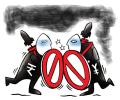
India and China have mostly set aside their bilateral differences in order to champion the cause of developing countries at the World Trade Organisation (WTO). That seems to be changing. During the latest round of China's trade policy review, India questioned its northern neighbour's claim that it was a developing country, since, going by the World Bank's definition, its per capita income belongs to that of an upper middle income country. "As per the per capita income level, the Chinese economy belongs to 'upper-middle income'. "How can China still claim to be a developing country? "What are the indicators which China is using to claim such a status?" India asked.

'Karna is the greatest warrior in the Mahabharata -- in fact, Arjuna is a nobody in front of Karna.' 'But Arjuna had a better advisor in Krishna than Karna.' 'Karna failed because he listened to the wrong advice given by Salya.' 'It just shows wrong advisors can land even the mighty in trouble.'
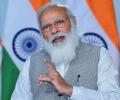
A faltering economy may have led to a re-think on economic strategy. And Mr Modi might think he is politically strong enough to take some risks. But there could be a minefield ahead, observes T N Ninan.
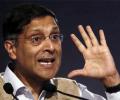
"It's a welcome development, but we also feel it was long overdue... It's a recognition of the actions that the government has undertaken like GST, bankruptcy. We also need to keep all these things in perspective," Chief Economic Adviser Arvind Subramanian said.

Prime Minister Rishi Sunak has made a clear break with the past on UK-China relations as he declared that the "so-called golden era" of bilateral ties is over in the face of the "systemic challenge" posed by the Chinese regime to British values and interests.

India and the United States settled a dispute on Thursday that had paralysed the World Trade Organization and risked derailing a $1 trillion package of reforms.

'There is only one common feature between Gorbachev and Putin.' 'They are both patriots, and both try to save Russia and make it great.' 'But in very, very, different ways.'

Sinha, a former finance minister, hogged the limelight and started trending high on social media on Wednesday after he criticised his own government for sinking economy in an article.
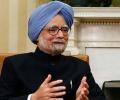
There is a need for tax reforms in the country in a bolder way, Singh said.
India's gross domestic product product (GDP) growth rate between 2011-12 and 2016-17 should be about 4.5 per cent instead of the official estimate of close to 7 per cent, he said in a research paper published at Harvard University. "The Indian policy automobile has been navigated with a faulty, possibly broken, speedometer," he says in the paper.
'The Budget numbers presented severely underestimate the magnitude of the unstated fiscal crisis that we went through in 2018-2019, which cannot be conceivably be fully reversed in 2019-2020,' points out Rathin Roy, director, National Institute of Public Finance and Policy.

The United Forum of Bank Unions (UFBU), an umbrella body of nine unions, has given a call for a two-day strike from December 16 to protest against the proposed privatisation of two state-owned lenders. In the Union Budget presented in February, Finance Minister Nirmala Sitharaman had announced the privatisation of two public sector banks (PSBs) as part of its disinvestment plan. The government has already privatised IDBI Bank by selling its majority stake in the lender to LIC in 2019 and merged 14 public sector banks in the past four years.

Foreign portfolio investor (FPI) flows into India may remain tepid in 2022, said a recent note by Goldman Sachs, who now peg the foreign portfolio investment into India at $5 billion in 2022, down from their earlier forecast of $30 billion with risks skewed to the downside. "There has been $15 billion of equity outflows YTD in India already, and the IPO of the largest insurance company has been pushed out. "Additionally, with no mention of India's inclusion in global bond indices in the Union Budget, there are risks to our already conservative base case assumption of an announcement of India's likely inclusion into the GBI-EM Global Diversified Bond Index in Q4-2022," wrote Andrew Tilton, Goldman Sachs' chief Asia-Pacific economist in a co-authored report with Santanu Sengupta and Suraj Kumar.
Investors believe Indian is a tough place to do business with.

'Indian macro conditions have never been better, and many businesses will safely compound earnings over the next five years.'
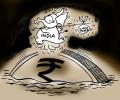
Fitch Ratings on Wednesday said India's high fiscal deficit would pose a challenge in lowering the debt to GDP ratio, which is expected to rise above 90 per cent in the next five years. It said India entered the pandemic with little fiscal headroom from a rating perspective. Its general government debt/GDP ratio stood at 72 per cent in 2019, against a median of 42 per cent for 'BBB' rated peers.

'What is unusual about the current period of slow growth is that it has come without an external driver -- high oil prices and/or successive monsoon failures -- as was the case with all previous periods of slowdown, going back 50 years, notes T N Ninan.

With economic growth slowing to a six-year low, IMF Chief Economist Gita Gopinath says the government should undertake structural reforms such as bank clean-up and labour reforms to address the slowdown in domestic demand. She rooted for government policies focusing on managing a slowdown in domestic demand, and on boosting productivity growth and supporting employment creation in the medium term.
It's time to step on the reforms accelerator.

Modi said it is an outcome of India's consistent reforms trajectory that the country's position is getting credence globally and is being recognised by international bodies like the IMF, World Economic Forum and UNCTAD.
From lack of big reforms to regressive tax policies, the Modi govt has surrendered its initial momentum, says Shishir Asthana.

US President-elect Joe Biden plans to increase the number of high-skilled visas, including H-1B, and eliminate the limit on employment-based visas by country, both of which are expected to benefit tens of thousands of Indian professionals impacted by some immigration policies of the outgoing Trump administration.

The Congress on Sunday gave a call to party leaders in poll-bound states to work with unity to ensure victory that will 'set the tone' for 2024 Lok Sabha polls even as it showed willingness to forge an alliance of 'like-minded' parties.

The government has the upper hand in the ongoing negotiations, and it is unclear if a real debate will happen, observes Tulika Narayan.

The Finance Ministry expects GDP growth to be 8-8.5 per cent in 2015-16.
While foreign currency rating was retained at Baa2 -- the second-lowest investment grade score -- Moody's also projected a fiscal deficit of 3.7 per cent of gross domestic product in the year through March 2020, a breach of the government's target of 3.3 per cent.

'We have to think of the repercussions if public sector banks are privatised and if they go to foreign hands.'

India has adopted a bilateral strategies with its immediate neighbouring countries for mutual benefits

Revenue buoyancy of GST will be key to improve the resource position of both central and state governments.
Hard selling India as an investment destination at the WEF, Modi said the government is following the principle of reform, perform and transform.
